DipCoatImage-FiniteDepth-IFD documentation#
API reference#
Finite depth dip coating uniformity measurement using integral Fréchet distance.
To reproduce the examples, run the following code first:
import cv2
from finitedepth import *
from finitedepth_ifd import *
- class finitedepth_ifd.IfdRoughnessBase(image, substrate, roughness_type, delta, *, tempmatch=None)[source]#
Base class to measure layer surface roughness with integral Fréchet distance.
The following types of roughness are supported:
Arithmetic roughness \(R_a\)
Quadratic mean roughness \(R_q\)
- Parameters:
- image, substrate
See
CoatingLayerBase.- roughness_type{‘arithmetic’, ‘quadratic’}
- deltadouble
The maximum distance between the Steiner points to compute the roughness. Refer to
roughness()for more explanation.
- Other Parameters:
- tempmatchtuple, optional
See
CoatingLayerBase.
- abstract surface()[source]#
Coating layer surface points.
- Returns:
- ndarray
An \(N\) by \(2\) array containing the \(xy\)-coordinates of \(N\) points which constitute the coating layer surface profile.
- abstract uniform_layer()[source]#
Imaginary uniform layer points.
- Returns:
- thicknessdouble
Thickness of the uniform layer.
- ndarray
An \(M\) by \(2\) array containing the \(xy\)-coordinates of \(M\) points which constitute the uniform layer profile.
- roughness()[source]#
Surface roughness of the coating layer.
- Returns:
- roughnessdouble
Roughness value.
- pathndarray
An \(P\) by \(2\) array representing the optimal warping path in the parameter space.
See also
curvesimilarities.averagefrechet.afdAverage Fréchet distance.
curvesimilarities.averagefrechet.qafdQuadratic average Fréchet distance.
Notes
The roughness is acquired by computing the similarity between
surface()anduniform_layer().
- class finitedepth_ifd.RectIfdRoughness(image, substrate, roughness_type, delta, opening_ksize, reconstruct_radius, *, tempmatch=None)[source]#
Measure layer surface roughness over rectangular substrate.
- Parameters:
- image
See
CoatingLayerBase.- substrate
RectSubstrate. Substrate instance.
- roughness_type, delta
See
IfdRoughnessBase.- opening_ksizetuple of int
Kernel size for morphological opening operation. Must be zero or odd.
- reconstruct_radiusint
Radius of the safe zone for noise removal. Two imaginary circles with this radius are drawn on bottom corners of the substrate. When extracting the coating layer, connected components not spanning over any of these circles are regarded as noise.
- Other Parameters:
- tempmatchtuple, optional
See
CoatingLayerBase.
Examples
Construct the substrate instance first.
>>> ref_img = cv2.imread(get_sample_path("ref.png"), cv2.IMREAD_GRAYSCALE)
>>> ref = Reference(
...     cv2.threshold(ref_img, 0, 255, cv2.THRESH_BINARY | cv2.THRESH_OTSU)[1],
...     (10, 10, 1250, 200),
...     (100, 100, 1200, 500),
... )
>>> subst = RectSubstrate(ref, 3.0, 1.0, 0.01)
Construct the coating layer instance.
>>> target_img = cv2.imread(get_sample_path("coat.png"), cv2.IMREAD_GRAYSCALE)
>>> coat = RectIfdRoughness(
...     cv2.threshold(target_img, 0, 255, cv2.THRESH_BINARY | cv2.THRESH_OTSU)[1],
...     subst,
...     "arithmetic",
...     5.0,
...     (1, 1),
...     50,
... )
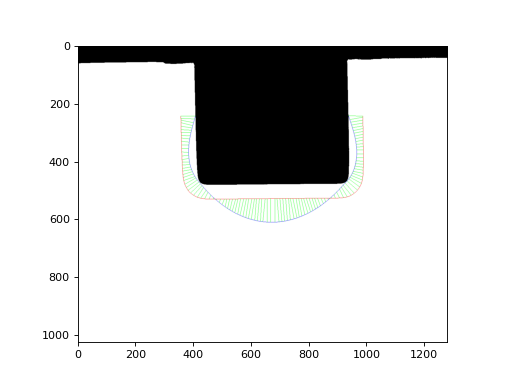
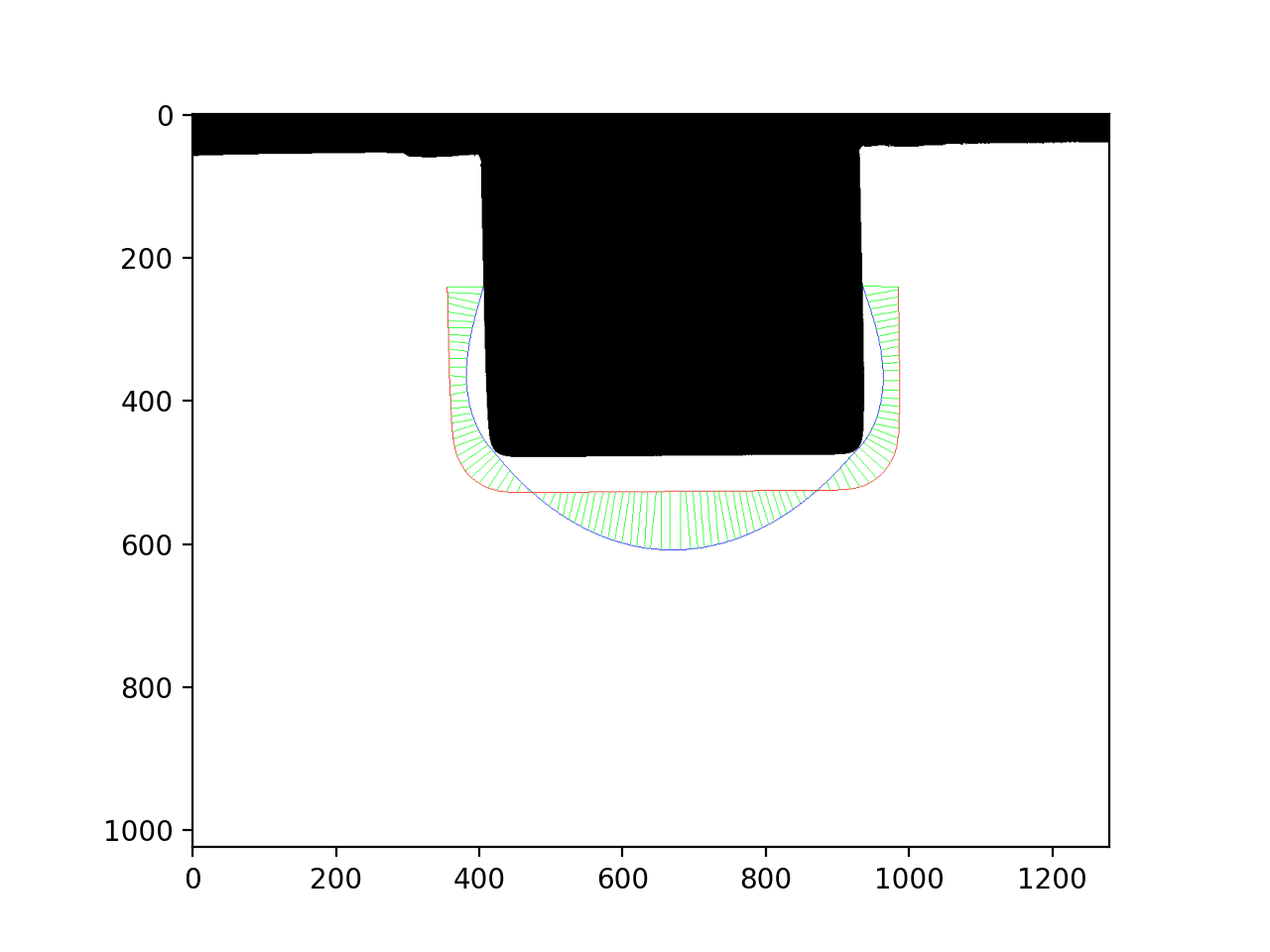
Visualize the coating layer.
>>> import matplotlib.pyplot as plt
>>> plt.imshow(coat.draw())
(
Source code,png,hires.png,pdf)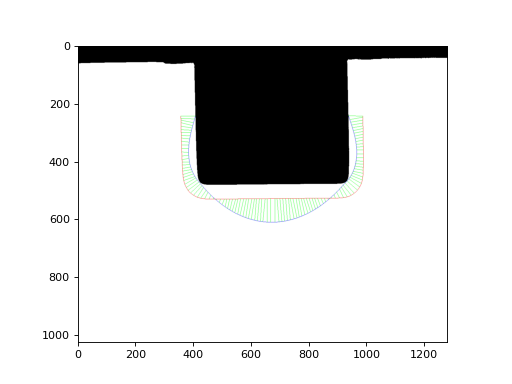
- DataType#
alias of
RectIfdRoughnessData
- valid()[source]#
Check if the coating layer is valid.
The coating layer is invalid if the capillary bridge is not ruptured.
- Returns:
- bool
- extract_layer()[source]#
Extract the coating layer region from the target image.
- Returns:
- ndarray of bool
An array where the coating layer region is True. Has the same shape as
image.
Notes
The following operations are performed to remove the error pixels:
Image opening with
opening_ksizeattribute.Reconstruct connected components using
reconstruct_radiusand and substrate vertices.
- interface_indices()[source]#
Return indices of the substrate contour for the solid-liquid interface.
The interface points can be retrieved by slicing the substrate contour with there indices.
- Returns:
- ndarray
Starting and ending indices for the solid-liquid interface, empty if the interface does not exist.
See also
substrate_contourThe substrate contour which can be sliced.
Notes
The interface is detected by finding the points on the substrate contour which are adjacent to the points in
extract_layer().
- class finitedepth_ifd.RectIfdRoughnessData(Roughness)[source]#
Analysis data for
RectIfdRoughness.- Attributes:
- Roughnessfloat
Coating layer roughness.